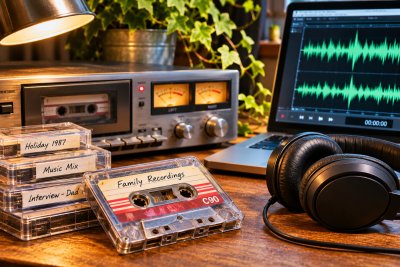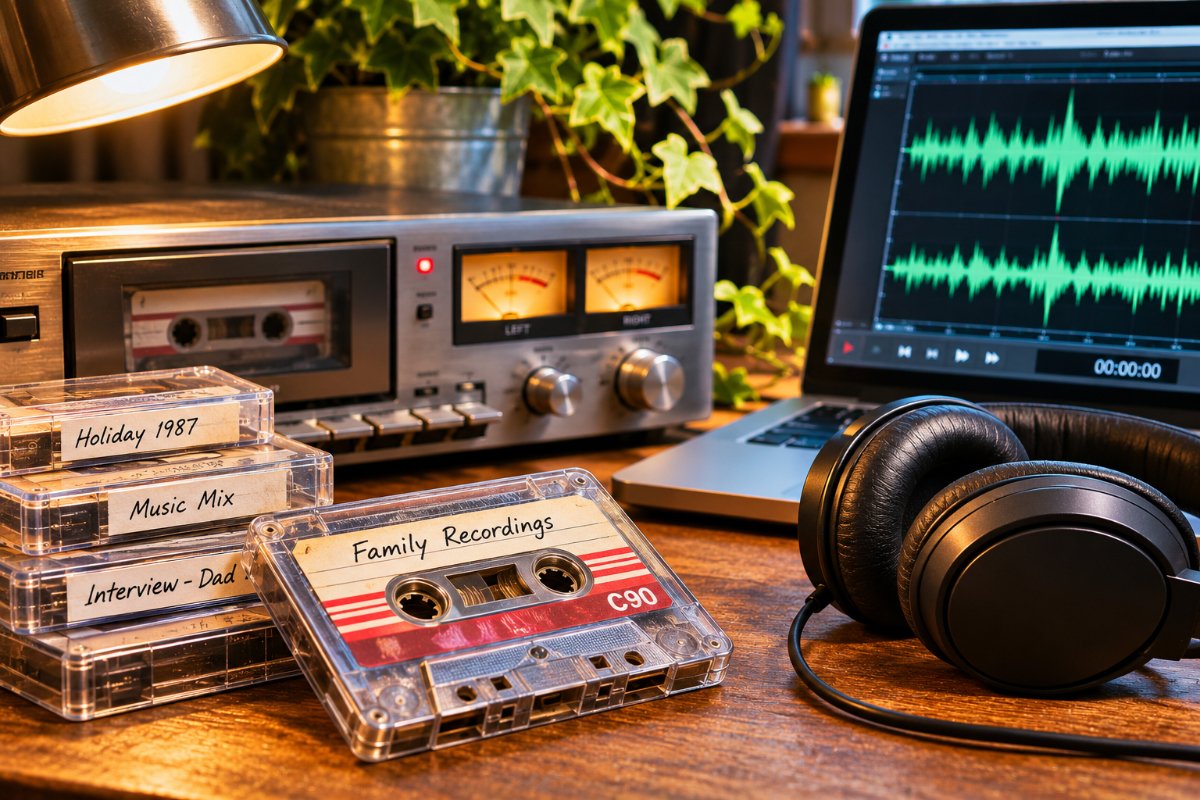
Then there were the family recordings, interviews, spoken letters and all sorts of other things captured on those little plastic cassettes.
Today, many of them are sitting forgotten in drawers and cupboards.
It Looks Simple Enough
You might think converting an audio cassette is straightforward.
Put the cassette into a player, connect it to a computer, press Play and record the sound.
And sometimes it really is that simple.
But old tapes have a habit of reminding us that technology doesn't always cooperate.
Why Does the Sound Wobble?
One problem you may encounter is audio that seems to speed up, slow down or wobble.
In the recording world, these variations are commonly called wow and flutter.
They can be caused by problems with the playback mechanism, such as worn belts, dirty components or inconsistent tape movement.
The cassette itself may also be responsible.
After decades in storage, the tape might not travel through the mechanism as smoothly as it once did.
And, of course, the original recording may already contain imperfections.
What About Hissing and Background Noise?
Anyone who remembers cassette tapes will be familiar with that gentle background hiss.
It's part of the technology.
Modern audio software can sometimes reduce unwanted noise, but there's a balance to be struck.
Remove too much, and you can make voices and music sound unnatural.
Personally, I'd rather preserve a recording with a little background noise than remove so much that the original character disappears.
Not Every Cassette Contains Music
Some of the most interesting recordings are ordinary conversations.
An interview with a grandparent, a family member telling stories or a child practising a song.
Those recordings may not have been particularly important when they were made.
But decades later, hearing a familiar voice can be incredibly moving.
Converting Audio Into Digital Files
Once transferred, audio recordings can be saved in formats such as WAV or MP3.
WAV is useful for retaining an uncompressed digital master, while MP3 provides smaller files that are convenient for sharing.
I generally think it's sensible to preserve the best practical original transfer before making any enhanced or compressed copies.
Don't Throw Those Cassettes Away
If you've discovered old audio cassettes, don't assume they're worthless simply because you no longer have a working player.
They may contain recordings that deserve to be heard again.
At Forest of Dean Scanning Services, I can help explore options for transferring old audio recordings into digital formats.
And who knows?
You might even rediscover that embarrassing recording of yourself singing along to the radio in 1985.
Some memories are priceless. Others are best enjoyed with the volume turned down!